n.
1.
a. A conversation between two or more people.
b. A discussion of positions or beliefs, especially between groups to resolve a disagreement.
2.
a. Conversation between characters in a drama or narrative.
b. The lines or passages in a script that are intended to be spoken.
3. A literary work written in the form of a conversation: the dialogues of Plato.
4. Music A composition or passage for two or more parts, suggestive of conve
cat·a·log or cat·a·logue (kăt′l-ôg′, -ŏg′)
n.
1.
a. A list or itemized display, as of titles, course offerings, or articles for exhibition or sale, usually including descriptive information or illustrations.
b. A publication, such as a book or pamphlet, containing such a list or display: a catalog of fall fashions; a seed catalog.
2. A list or enumeration: a catalog of complaints.
3. A card catalog.
v. cat·a·loged, cat·a·log·ing, cat·a·logs or cat·a·logued or cat·a·logu·ing or cat·a·logues
v.tr.
1. To make an itemized list of: catalog a record collection.
2.
a. To list or include in a catalog.
b. To classify (a book or publication, for example) according to a categorical system.
v.intr.
1. To make a catalog.
2. To be listed in a catalog: an item that catalogs for 200 dollars.
theatre (ˈθɪətə) or theater
n
1. (Theatre)
a. a building designed for the performance of plays, operas, etc
b. (as modifier): a theatre ticket.
c. (in combination): a theatregoer.
2. a large room or hall, usually with a raised platform and tiered seats for an audience, used for lectures, film shows, etc
3. (Surgery) Also called: operating theatre a room in a hospital or other medical centre equipped for surgical operations
4. (Theatre) plays regarded collectively as a form of art
5. (Theatre) the theatre the world of actors, theatrical companies, etc: the glamour of the theatre.
6. a setting for dramatic or important events
7. (Theatre) writing that is suitable for dramatic presentation: a good piece of theatre.
8. (Film) US and Austral and NZ the usual word for cinema1
9. (Military) a major area of military activity: the theatre of operations.
10. (Architecture) a circular or semicircular open-air building with tiers of seats
the·a·ter or the·a·tre (thē′ə-tər)
n.
1. A building, room, or outdoor structure for the presentation of plays, films, or other dramatic performances.
2. A room with tiers of seats used for lectures or demonstrations: an operating theater at a medical school.
3.
a. Dramatic literature or its performance; drama: the theater of Shakespeare and Marlowe.
b. The milieu of actors and playwrights.
4.
a. The quality or effectiveness of a theatrical production: good theater; awful theater.
b. Dramatic material or the use of such material: "His summation was a great piece of courtroom theater" (Ron Rosenbaum).
5. The audience assembled for a dramatic performance.
6. A place that is the setting for dramatic events.
7. A large geographic area in which military operations are coordinated: the European theater during World War II.
The Garden of Eden
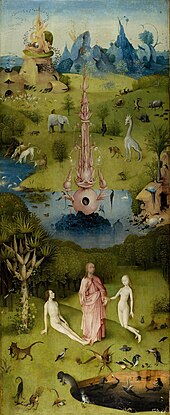
The Garden of Eden (Hebrew גַּן עֵדֶן, Gan ʿEḏen) is the biblical "garden of God", described most notably in the Book of Genesis chapters 2 and 3, and also in the Book of Ezekiel.[2] The "garden of God", not called Eden, is mentioned in Genesis 14, and the "trees of the garden" are mentioned in Ezekiel 31. The Book of Zechariah and the Book of Psalms also refer to trees and water in relation to the temple without explicitly mentioning Eden.
Senior prom 畢業舞會
在美國和加拿大,prom(promenade的簡寫形式)指為中學生舉辦的正式舞會或聚會,通常在高中學年即將結束時舉行,(所以很多地方都譯作“畢業舞會”)。有初中生參加的叫Junior Prom,高中生的則叫Senior Prom。不過在具體組織的時候,這種舞會通常既有初中生也有高中生。
Apostles
According to the Bible's New Testament, the Apostles were the primary disciples of Jesus, the central figure in Christianity. During the life and ministry of Jesus in the first century AD, the apostles were his closest followers and became the primary teachers of the gospel message of Jesus. The word "disciple" is sometimes used interchangeably with "apostle" – for instance the Gospel of John makes no distinction between the two terms. In modern usage, prominent missionaries are identified as apostles – a practice which stems from the Latin equivalent of apostle, missio, the source of the English word "missionary".
Paul the Apostle

Paul the Apostle (Greek: Παῦλος Paulos; c. 5 – c. 67), originally known as Saul of Tarsus (Hebrew: שאול התרסי; Greek: Σαῦλος Ταρσεύς Saulos Tarseus),[1][2] was an apostle (though not one of the Twelve Apostles) who taught the gospel of Christ to the first-century world.[7] He is generally considered one of the most important figures of the Apostolic Age.[8][9] In the mid-30s to the mid-50s, he founded several churches in Asia Minor and Europe. Paul used his status as both a Jew and a Roman citizen to advantage in his ministry to both Jewish and Roman audiences.
Joseph Conrad
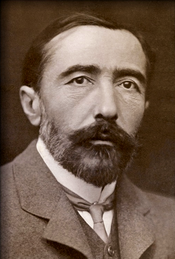
Joseph Conrad (born Józef Teodor Konrad Korzeniowski;3 December 1857 – 3 August 1924) was a Polish author who wrote in English after settling in England.[1] He was granted British nationality in 1886, but always considered himself a Pole.[note 1] Conrad is regarded as one of the greatest novelists in English,[2] and though he did not speak the language fluently until he was in his twenties (and always with a marked accent), he was a master prose stylist who brought a distinctly non-English sensibility into English literature.[note 2] [3] He wrote stories and novels, many with a nautical setting, that depict trials of the human spirit in the midst of an indifferent universe. However, the sea is not an important element in major works like Nostromo, The Secret Agent and Under Western Eyes.

沒有留言:
張貼留言