ob
prefix
1.
inverse or inversely: obovate
Word Origin
from Old French, from Latin ob. In compound words of Latin origin, ob- (and oc-, of-, op-) indicates: to, towards ( object); against ( oppose); away from ( obsolete); before ( obstetric); down, over ( obtect); for the sake of ( obsecrate); and is used as an intensifier ( oblong)
adjective
opposite
[op-uh-zit, -sit]
1.
situated, placed, or lying face to face with something else or each other, or in corresponding positions with relation to an intervening line, space, or thing:
opposite ends of a room.
2.
contrary or radically different in some respect common to both, as in nature, qualities, direction, result, or significance; opposed:
opposite sides in a controversy; opposite directions.
3.
being the other of two related or corresponding things:
friendly with many members of the opposite sex.
4.
Botany.
- situated on diametrically opposed sides of an axis, as leaves when there are two on one node.
- having one organ vertically above another; superimposed.
5.
adverse or inimical.
opponent
[uh-poh-nuh nt]
1.
a person who is on an opposing side in a game, contest, controversy, or the like; adversary.
2.
being opposite, as in position.
3.
opposing; adverse; antagonistic.
4.
-----------------------------------------------------------------------------
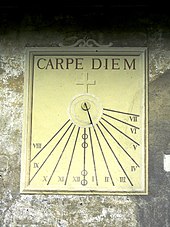
A sundial inscribed "carpe diem"
-------------------------------------------------------------------
Fantasy is a genre of fiction that commonly uses magic and other supernatural phenomena as a primary plot element, theme, or setting. Many works within the genre take place in imaginary worlds where magic and magical creatures are common. Fantasy is generally distinguished from the genres of science fiction and horror by the expectation that it steers clear of scientific and macabre themes, respectively, though there is a great deal of overlap between the three, all of which are subgenres of speculative fiction.
In popular culture, the fantasy genre is predominantly of the medievalist form. In its broadest sense, however, fantasy comprises works by many writers, artists, filmmakers, and musicians, from ancient myths and legends to many recent works embraced by a wide audience today.
Fantasy is studied in a number of disciplines (English, cultural studies, comparative literature, history, medieval studies). Work in this area ranges widely, from the structuralist theory of Tzvetan Todorov, which emphasizes the fantastic as a liminal space, to work on the connections (political, historical, literary) between medievalism and popular culture.[1]
3 Fantasy Books: Harry Potter, Narnia, and The Lord of the Rings
-------------------------------------------------------------------
A parable is a succinct, didactic story, in prose or verse, which illustrates one or more instructive lessons or principles. It differs from a fable in that fables employ animals, plants, inanimate objects, or forces of nature as characters, whereas parables have human characters[citation needed]. A parable is a type of analogy.[1]
Some scholars of the canonical gospels and the New Testament apply the term "parable" only to the parables of Jesus,[2][3] though that is not a common restriction of the term. Parables such as "The Prodigal Son" are central to Jesus' teaching method in both the canonical narratives and the apocrypha.
Give me a rationale I can do it
Anatomy. bringing parts together or into opposition, as a muscle.
-----------------------------------------------------------------------------
A sundial inscribed "carpe diem"
Carpe diem is a Latin aphorism usually translated to "seize the day", taken from a poem in the Odes (book 1, number 11) in 23 BC by the poet Horace.
------------------------------------------------------------------------------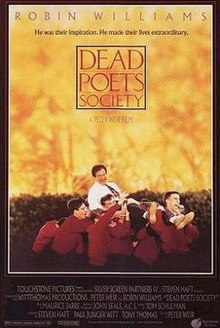
Dead Poets Society
Dead Poets Society
Dead Poets Society is a 1989 American drama film written by Tom Schulman, directed by Peter Weir and starring Robin Williams. Set at the conservative and aristocratic Welton Academy in the northeast United States in 1959, it tells the story of an English teacher who inspires his students through his teaching of poetry.
The film received critical acclaim and box office success; it was also BAFTA's best film and best foreign film in France and Italy. Schulman received an Academy Award for Best Original Screenplay for his work.
-------------------------------------------------------------------

Dante, Homer and Virgil in Raphael's Parnassus fresco (1511), in which the Western canon is visualised
The term "Western canon" denotes a body of books and, more broadly, music and art that have been traditionally accepted by Western scholars as the most important and influential in shaping Western culture. As such, it includes the "greatest works of artistic merit". Such a canon is important to the theory of educational perennialism and the development of "high culture". The idea of a Canon has been used to address the question What is Art?; according to this approach, a work is art by comparison to the works in the canon, or conversely, any aesthetic law to be valid should not rule out any of the works included in the canon.The concept has become challenged by advocates of multiculturalism and critics who charge that it has been influenced by race, gender, and other biases.
The film received critical acclaim and box office success; it was also BAFTA's best film and best foreign film in France and Italy. Schulman received an Academy Award for Best Original Screenplay for his work.
-------------------------------------------------------------------
Dante, Homer and Virgil in Raphael's Parnassus fresco (1511), in which the Western canon is visualised
The term "Western canon" denotes a body of books and, more broadly, music and art that have been traditionally accepted by Western scholars as the most important and influential in shaping Western culture. As such, it includes the "greatest works of artistic merit". Such a canon is important to the theory of educational perennialism and the development of "high culture". The idea of a Canon has been used to address the question What is Art?; according to this approach, a work is art by comparison to the works in the canon, or conversely, any aesthetic law to be valid should not rule out any of the works included in the canon.The concept has become challenged by advocates of multiculturalism and critics who charge that it has been influenced by race, gender, and other biases.
-------------------------------------------------------------------
Fantasy is a genre of fiction that commonly uses magic and other supernatural phenomena as a primary plot element, theme, or setting. Many works within the genre take place in imaginary worlds where magic and magical creatures are common. Fantasy is generally distinguished from the genres of science fiction and horror by the expectation that it steers clear of scientific and macabre themes, respectively, though there is a great deal of overlap between the three, all of which are subgenres of speculative fiction.
In popular culture, the fantasy genre is predominantly of the medievalist form. In its broadest sense, however, fantasy comprises works by many writers, artists, filmmakers, and musicians, from ancient myths and legends to many recent works embraced by a wide audience today.
Fantasy is studied in a number of disciplines (English, cultural studies, comparative literature, history, medieval studies). Work in this area ranges widely, from the structuralist theory of Tzvetan Todorov, which emphasizes the fantastic as a liminal space, to work on the connections (political, historical, literary) between medievalism and popular culture.[1]
3 Fantasy Books: Harry Potter, Narnia, and The Lord of the Rings
-------------------------------------------------------------------
A parable is a succinct, didactic story, in prose or verse, which illustrates one or more instructive lessons or principles. It differs from a fable in that fables employ animals, plants, inanimate objects, or forces of nature as characters, whereas parables have human characters[citation needed]. A parable is a type of analogy.[1]
Some scholars of the canonical gospels and the New Testament apply the term "parable" only to the parables of Jesus,[2][3] though that is not a common restriction of the term. Parables such as "The Prodigal Son" are central to Jesus' teaching method in both the canonical narratives and the apocrypha.
Give me a rationale I can do it
-------------------------------------------------------------------
Difference
Allegory: A story in which ideas are symbolized as people.
Parable: A short story designed to teach a moral or religious lesson.
Fable: A short story in which animals or objects speaks a story, to teach a moral or religious lesson.

沒有留言:
張貼留言