
2015年4月16日 星期四

Week 8 青少年小說 (Discussing our writing paper.)


Mockingbird
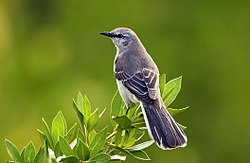
Mockingbirds are a group of New World passerine birds from the Mimidae family. They are best known for the habit of some species mimicking the songs of other birds and the sounds of insects and amphibians,[1] often loudly and in rapid succession. There are about 17 species in three genera. These do not appear to form a monophyletic lineage: Mimus and Nesomimus are quite closely related; their closest living relatives appear to be some thrashers, such as the sage thrasher. Melanotis is more distinct; it seems to represent a very ancient basal lineage of Mimidae.
American Robin

The American robin (Turdus migratorius) is a migratory songbird of the thrush family. It is named after the European robin[2] because of its reddish-orange breast, though the two species are not closely related, with the European robin belonging to the Old World flycatcher family. The American robin is widely distributed throughout North America, wintering from southern Canada to central Mexico and along the Pacific Coast. It is the state bird of Connecticut, Michigan, and Wisconsin.[3] According to some sources, the American robin ranks behind only the red-winged blackbird (and just ahead of the introduced European starling and the not-always-naturally occurring house finch) as the most abundant, extant land bird in North America.[4] It has seven subspecies, but only T. m. confinis of Baja California Sur is particularly distinctive, with pale gray-brown underparts.
The American robin is active mostly during the day and assembles in large flocks at night. Its diet consists of invertebrates (such as beetle grubs, earthworms, and caterpillars), fruits, and berries. It is one of the earliest bird species to lay eggs, beginning to breed shortly after returning to its summer range from its winter range. Its nest consists of long coarse grass, twigs, paper, and feathers, and is smeared with mud and often cushioned with grass or other soft materials. It is among the first birds to sing at dawn, and its song consists of several discrete units that are repeated.
知更鳥是所有鳥類中,英國人們最熟悉、最喜歡的一種小鳥,
為英國國鳥。
英文俗名『Robin』,台灣有人翻譯成『知更鳥』,
知道早晨的更替,有點先知先覺的感覺
| Edgar Allan Poe |
|---|
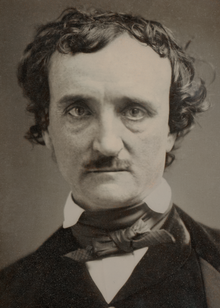
Edgar Allan Poe (/poʊ/; born Edgar Poe; January 19, 1809 – October 7, 1849) was an American author, poet, editor, and literary critic, considered part of the American Romantic Movement. Best known for his tales of mystery and the macabre, Poe was one of the earliest American practitioners of the short story, and is generally considered the inventor of the detective fiction genre. He is further credited with contributing to the emerging genre of science fiction.[1] He was the first well-known American writer to try to earn a living through writing alone, resulting in a financially difficult life and career.
"The Tell-Tale Heart"
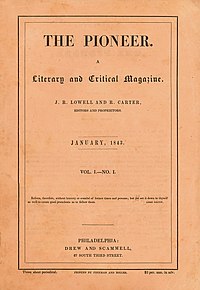
"The Tell-Tale Heart" is a short story by Edgar Allan Poe first published in 1843. It is told by an unnamed narrator who endeavors to convince the reader of his sanity, while describing a murder he committed. (The victim was an old man with a filmy "vulture-eye", as the narrator calls it.) The murder is carefully calculated, and the murderer hides the body by dismembering it and hiding it under the floorboards. Ultimately the narrator's guilt manifests itself in the form of the sound—possibly hallucinatory—of the old man's heart still beating under the floorboards.
2015年4月9日 星期四
Week 7 青少年小說
Get Met It Pays
man- hand, make
manipulate
[muh-nip-yuh-leyt]
verb (used with object), manipulated, manipulating.
1.
to manage or influence skillfully, especially in an unfair manner:
to manipulate people's feelings.
2.
to handle, manage, or use, especially with skill, in some process of treatment or performance:
to manipulate a large tractor.
3.
to adapt or change (accounts, figures, etc.) to suit one's purpose or advantage.
4.
Medicine/Medical. to examine or treat by skillful use of the hands, as in palpation, reduction of dislocations, or changing the position of a fetus.
manufacture
[man-yuh-fak-cher]
noun
1.
the making of goods or wares by manual labor or by machinery, especially on a large scale:
the manufacture of television sets.
2.
the making or producing of anything; generation:
the manufacture of body cells.
3.
the thing or material manufactured; product:
Plastic is an important manufacture.
verb (used with object), manufactured, manufacturing.
4.
to make or produce by hand or machinery, especially on a large scale.
5.
to work up (material) into form for use:
to manufacture cotton.
6.
to invent fictitiously; fabricate; concoct:
to manufacture an account of the incident.
7.
to produce in a mechanical way without inspiration or originality:
to manufacture a daily quota of poetry.
Hermitage Museum
The State Hermitage (Russian: Госуда́рственный Эрмита́ж; IPA: [gəsʊˈdarstvʲɪnɨj ɪrmʲɪˈtaʂ], Gosudarstvenny Ermitazh) is amuseum of art and culture in Saint Petersburg, Russia. One of the largest[2][3] and oldest museums in the world, it was founded in 1764 by Catherine the Great and has been open to the public since 1852. Its collections, of which only a small part is on permanent display, comprise over three million items,[4] including the largest collection of paintings in the world. The collections occupy a large complex of six historic buildings along Palace Embankment, including the Winter Palace, a former residence of Russian emperors. Apart from them, the Menshikov Palace, Museum of Porcelain, Storage Facility at Staraya Derevnya and the eastern wing of the General Staff Building are also part of the museum. The museum has several exhibition centers abroad. The Hermitage is a federal state property. Since 1990, the director of the museum has been Mikhail Piotrovsky.
大藏寶家
The Monuments Men
Enter game, program
Participate X awkward
Se- apart from
segregate
[v. seg-ri-geyt; n. seg-ri-git, -geyt]
verb (used with object), segregated, segregating.
1.
to separate or set apart from others or from the main body or group; isolate:
to segregate exceptional children; to segregate hardened criminals.
2.
to require, by law or custom, the separation of (an ethnic, racial, religious, or other minority group) from the dominant majority.
verb (used without object), segregated, segregating.
3.
to separate, withdraw, or go apart; separate from the main body and collect in one place; become segregated.
4.
to practice, require, or enforce segregation, especially racial segregation.
5.
Genetics. (of allelic genes) to separate during meiosis.
noun
6.
a segregated thing, person, or group.
select
[si-lekt]
verb (used with object)
1.
to choose in preference to another or others; pick out.
verb (used without object)
2.
to make a choice; pick.
adjective
3.
chosen in preference to another or others; selected.
Synonyms: preferred.
4.
choice; of special value or excellence.
5.
careful or fastidious in selecting; discriminating.
6.
carefully or fastidiously chosen; exclusive:
a select group of friends.
separate
[v. sep-uh-reyt; adj., n. sep-er-it]
verb (used with object), separated, separating.
1.
to keep apart or divide, as by an intervening barrier or space:
to separate two fields by a fence.
2.
to put, bring, or force apart; part:
to separate two fighting boys.
3.
to set apart; disconnect; dissociate:
to separate church and state.
4.
to remove or sever from association, service, etc., especially legally or formally:
He was separated from the army right after V-E Day.
5.
to sort, part, divide, or disperse (an assemblage, mass, compound, etc.), as into individual units, components, or elements.
6.
to take by parting or dividing; extract (usually followed by from or out):
to separate metal from ore.
7.
Mathematics. to write (the variables of a differential equation) in a form in which the differentials of the independent and dependent variables are, respectively, functions of these variables alone:
We can separate the variables to solve the equation.
Compare separation of variables.
Anna Helene Paquin (/ˈpækwɪn/; born 24 July 1982)

is a Canadian-born New Zealand actress.[1][2] Her first film was The Piano, for which she won the Academy Award for Best Supporting Actress in March 1994 at the age of 11, making her the second youngest winner in Oscar history.[3] She later appeared in a number of successful films, including Fly Away Home, She's All That, Almost Famous, and the X-Men franchise as Rogue from Marvel Comics.
A Room with a View is a 1908 novel by English writer E. M. Forster, about a young woman in the repressed culture of Edwardian era England. Set in Italy and England, the story is both a romance and a critique of English society at the beginning of the 20th century. Merchant-Ivory produced an award-winning film adaptation in 1985.
The Modern Library ranked A Room with a View 79th on its list of the 100 best English-language novels of the 20th century (1998).
Helena Bonham Carter CBE

(born 26 May 1966) is an English actress. She made her acting debut in a television adaptation of K. M. Peyton's A Pattern of Roses before her debut film role as the titular character in Lady Jane. She is known for her roles in films, such as A Room with a View, Fight Club, The King's Speech, and playing Bellatrix Lestrange in the Harry Potter series. She has frequently collaborated with director Tim Burton, in films Planet of the Apes, Big Fish, Corpse Bride, Charlie and the Chocolate Factory, Sweeney Todd: The Demon Barber of Fleet Street, Alice in Wonderland, and Dark Shadows. In 2012, she played Miss Havisham in Great Expectations, and Madame Thénardier in Les Misérables.
A two-time Academy Award nominee for her performances as Kate Croy in The Wings of the Dove and as Queen Elizabeth The Queen Mother in The King's Speech, Bonham Carter's acting has been further recognised with seven Golden Globe nominations, an International Emmy Award for best actress, three Primetime Emmy Award nominations, a BAFTA Award, and a Screen Actors Guild Award. She was made a Commander of the Order of the British Empire (CBE) in the 2012 New Year honours list for services to drama,[1][2] and received the honour from the Queen at Buckingham Palace on 22 February 2012.[3]
In January 2014, British Prime Minister David Cameron announced that Bonham Carter had been appointed to Britain's new national Holocaust Commission.[4]
2015年4月2日 星期四

訂閱:
文章 (Atom)