Divine Comedy
"The Divine Comedy" redirects here. For other uses, see The Divine Comedy (disambiguation).
"La commedia" redirects here. For other uses, see Commedia (disambiguation).
The Divine Comedy (Italian: Divina Commedia) is an epic poem written by Dante Alighieri between c. 1308 and his death in 1321. It is widely considered the preeminent work of Italian literature,[1] and is seen as one of the greatest works of world literature.[2] The poem's imaginative and allegorical vision of the afterlife is representative of the medieval world-view as it had developed in the Western Church by the 14th century. It helped establish the Tuscan language, in which it is written, as the standardized Italian language.[3] It is divided into three parts: Inferno, Purgatorio, and Paradiso.
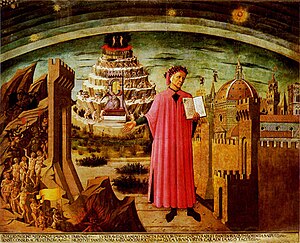
next to the entrance to Hell, the seven terraces of
Mount Purgatory and the city of Florence, with the
spheres of Heaven above, in Michelino's fresco
Florence 百花大教堂 dome
Inferno

Inferno is a 2013 mystery thriller novel by American author Dan Brown and the fourth book in his Robert Langdon series, following Angels & Demons, The Da Vinci Code and The Lost Symbol.[1] The book was released on May 14, 2013 by Doubleday.[2] It was number one on the New York Times Best Seller list for hardcover fiction and Combined Print & E-book fiction for the first eleven weeks of its release, and also remained on the list of E-book fiction for the first seventeen weeks of its release.

paradiso
Charles Perrault

Charles Perrault (12 January 1628 – 16 May 1703) was a French author and member of the Académie française. He laid the foundations for a new literary genre, the fairy tale, with his works derived from pre-existing folk tales. The best known of his tales include Le Petit Chaperon rouge (Little Red Riding Hood), Cendrillon (Cinderella), Le Chat Botté (Puss in Boots), La Belle au bois dormant (The Sleeping Beauty) and La Barbe bleue (Bluebeard).[1] Many of Perrault's stories, which were rewritten by the Brothers Grimm, continue to be printed and have been adapted to opera, ballet (such as Tchaikovsky's The Sleeping Beauty), theatre, and film. Perrault was an influential figure in the 17th-century French literary scene, and was the leader of the Modern faction during the Quarrel of the Ancients and the Moderns.
Lowly worm : look like
what was he like?
what's it like?
Naming/ describing
Sorting/ grouping (show≠tell)
Thems: finding/ retrieving
lost/ find
dream/ adventure
friendship/ leadership

沒有留言:
張貼留言