Examples Word Origin
1.
a Latin prefix meaning “apart,” “asunder,” “away,” “utterly,” or having a privative, negative, or reversing force (see de-, un-2.); used freely, especially with these latter senses, as an English formative:
disability; disaffirm; disbar; disbelief; discontent; dishearten; dislike; disown.
disable
[dis-ey-buh l] Spell Syllables
Synonyms Examples Word Origin
verb (used with object), disabled, disabling.
1.
to make unable or unfit; weaken or destroy the capability of; incapacitate: The detective successfully disabled the bomb.
He was disabled by the accident.
2.
to make legally incapable; disqualify.
dissolve
[dih-zolv] Spell Syllables
Synonyms Examples Word Origin
verb (used with object), dissolved, dissolving.
1.
to make a solution of, as by mixing with a liquid; pass into solution:
to dissolve salt in water.
2.
to melt; liquefy:
to dissolve sugar into syrup.
3.
to undo (a tie or bond); break up (a connection, union, etc.).
4.
to break up (an assembly or organization); dismiss; disperse.
5.
Government. to order the termination of (a parliament or other legislative body).
6.
to bring to an end; terminate; destroy:
to dissolve one's hopes.
7.
to separate into parts or elements; disintegrate.
discard
[v. dih-skahrd; n. dis-kahrd] Spell Syllables
Examples Word Origin
verb (used with object)
1.
to cast aside or dispose of; get rid of:
to discard an old hat.
2.
Cards.
to throw out (a card or cards) from one's hand.
to play (a card, not a trump, of a different suit from that of the card led).
verb (used without object)
3.
Cards. to discard a card or cards.
noun
4.
the act of discarding.
5.
a person or thing that is cast out or rejected.
6.
Cards. a card or cards discarded.
---------------------------------------------------------------------------------------------
---------------------------------------------------------------------------------------------
I feel shameful.
pro- in favor of, many, much
Aesop is reported as a prolific writer , for he wrote many works at his time.

The V. Rev. Dr Jonathan Swift
Jonathan Swift (30 November 1667 – 19 October 1745) was an Anglo-Irish[1] satirist, essayist, political pamphleteer (first for the Whigs, then for the Tories), poet and cleric who became Dean of St Patrick's Cathedral, Dublin.[2]
He is remembered for works such as Gulliver's Travels, A Modest Proposal, A Journal to Stella, Drapier's Letters, The Battle of the Books, An Argument Against Abolishing Christianity, and A Tale of a Tub. Swift is regarded by the Encyclopædia Britannica as the foremost prose satirist in the English language,[1] and is less well known for his poetry. Swift originally published all of his works under pseudonyms – such as Lemuel Gulliver, Isaac Bickerstaff, MB Drapier – or anonymously. He is also known for being a master of two styles of satire: the Horatian and Juvenalian styles.
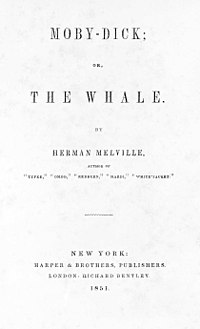
Moby-Dick; or, The Whale
Moby-Dick; or, The Whale
Moby-Dick; or, The Whale (1851) is a novel by Herman Melville, in which Ishmael narrates the monomaniacal quest of Ahab, captain of the whaler Pequod, for revenge on the albino sperm whale Moby Dick, which on a previous voyage destroyed Ahab's ship and severed his leg at the knee. Although the novel was a commercial failure and out of print at the time of the author's death in 1891, its reputation grew immensely during the twentieth century. D. H. Lawrence called it "one of the strangest and most wonderful books in the world," and "the greatest book of the sea ever written."[1] Moby-Dick is considered a Great American Novel and an outstanding work of theRomantic period in America and the American Renaissance. "Call me Ishmael" is one of world literature's most famous opening sentences.

沒有留言:
張貼留言